


Mouth guards for bruxism
Bruxism is an involuntary gnashing of teeth. It occurs most often at night and is caused by spasm of the masticatory muscles. If the problem occurs regularly, there is an increased risk of damage to tooth enamel (pathological abrasion) and even temporomandibular joint dysfunction.
There are different ways to deal with bruxism. Psychotherapy, hypnosis, acupuncture, meditation techniques and other relaxation methods are often used to relax the jaw muscles. In dental practice, a bruxism mouth guard is considered the most effective and quite simple method of solving the problem.
We at the DENTART clinic in Kyiv also offer our patients this treatment option. We use lab-made mouth guards, which are fast, efficient and fully supervised by our gnathologists.
Make an appointment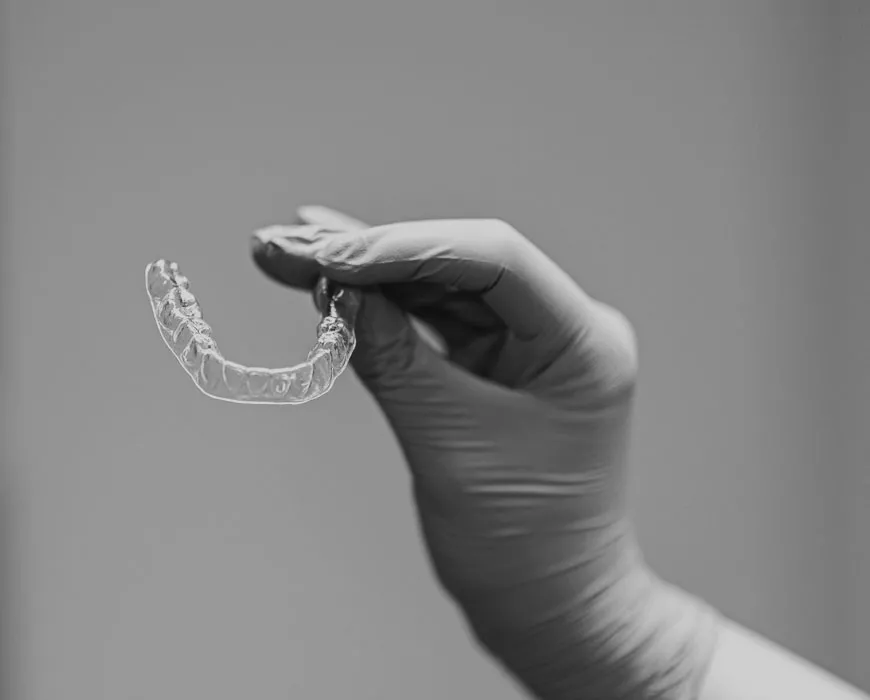


Gnathologists in Kyiv






How does bruxism manifest itself and why should it be dealt with?
Involuntary nocturnal grinding of the teeth causes abnormal distribution of stress on the masticatory muscles and their spasm. The grinding or tapping episodes last about 10 seconds and can occur with varying frequency, ranging from isolated episodes to multiple repetitions each night.
Bruxism is usually noticed by family and friends, as the patient is asleep at the time. But there are also some indirect symptoms that help to suspect the problem:
- morning pain in the neck and jaw;
- headache;
- tinnitus;
- vertigo;
- daytime sleepiness;
- bad sleep, etc.
Episodic bruxism attacks are not too dangerous. But if the problem is regular, the risk of tooth enamel deterioration increases. This is referred to as pathological abrasion. The temporomandibular joint (TMJ) also suffers: TMJ dysfunction can develop.
Bruxism also affects the quality of dental treatment, including the correction of bite, restoration of teeth with fillings, veneers, crowns etc. If the pathology is left untreated, the longevity of restorations and fillings is decreased and the range of suitable treatments is considerably smaller. Bruxism also results in more frequent oral trauma, gum and periodontal inflammation.
This is why a mouth guard for bruxism is not a recommendation, but a necessity.
What is a mouth guard for bruxism?
These are transparent on the upper and lower teeth, which are made of flexible plastic or silicone. Their main function is protective. What does a mouth guard help protect?
- tooth enamel from abrasion;
- crowns and other prostheses — from mechanical damage and accelerated wear;
- periodontal tissues — from inflammation and other pathological processes that occur against the background of damage;
- muscles and jaws — from unwanted pressure and overstrain.
As a result, muscle tone improves and the bruxism mouth guard helps relieve most of the symptoms —above all pain in the jaw, head and neck.
The mouth guards can be standard (more affordable) or custom-made (taking into account the particular dental structure of the individual patient). The latter require little or no getting used to, are comfortable and help quickly.
These devices are also sometimes classified according to their intended purpose. An overnight dental mouth guard is most often recommended, but there may also be indications for daytime wear. In this case, the product should be transparent and as invisible as possible to others. Note that overnight models are also often transparent, but this is not a prerequisite. The main thing is to ensure that the night-time mouthguard does not interfere with your rest or come off while you sleep.
Why you should order bruxism mouth-guards in DENTART?
The choice of mouth guards is quite large. For example, inexpensive standard and thermoplastic models are available. The latter take the shape of the patient's teeth the first time they are used. The most effective, of course, are custom-made mouth guards for the individual patient. These are the models we offer at DENTART.
These mouth guards not only protect the teeth, but also help to redistribute stress on the jaw muscles and eliminate the root cause of grinding — muscle spasms.
If there is the slightest discomfort while adapting to the tray, we will correct the problem.
Any questions? Call us or make an appointment to see the orthopaedic gnathologist at our clinic in Kyiv.


