


Caries treatment in Kiev
Caries is one of the most common and rather insidious dental diseases. It causes the destruction of tooth enamel, and then dentin, which is often referred to in everyday life as a “hole". Without proper treatment, the active development of the carious process occurs. Caries leads to inflammation, there are risks of tooth loss. To prevent this from happening, contact a dentist at our clinic DENTART in Kyiv at the first manifestation of this disease - darkening of the tooth enamel..
Our doctors treat tooth decay to world-class standards, including microscopy and the use of latex insulation (cofferdam). Our specialists' extensive experience and modern equipment make everything painless, quick and precise, removing only the damaged tissue and preserving the healthy tissue. Make an appointment via the website or by phone.
Make an appointment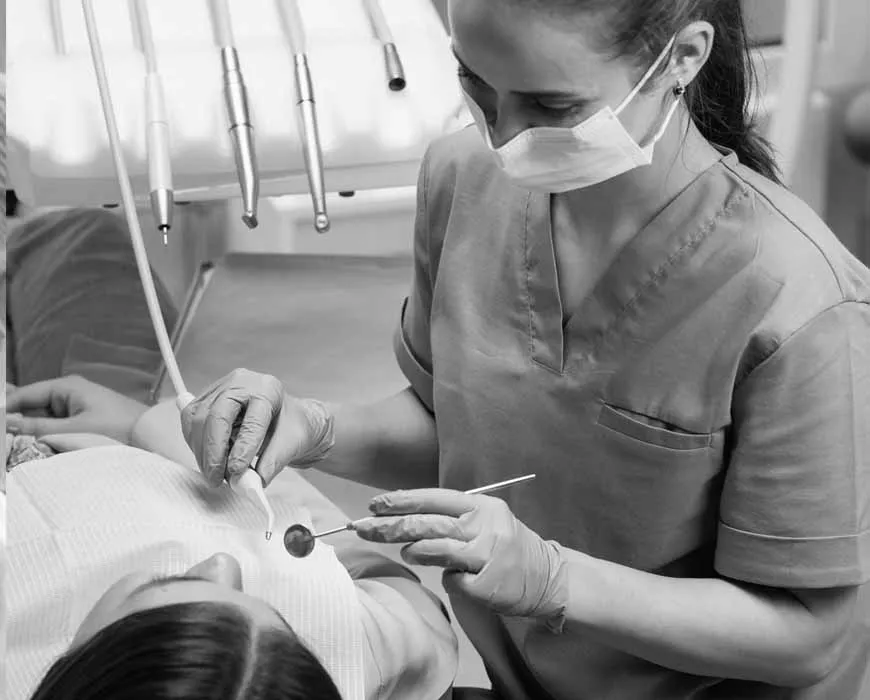

The benefits of dental caries treatment at DENTART clinic
The main reasons to choose our services include the following:
- We treat using latex tooth insulation (cofferdam). As a result, saliva does not get on the tooth during filling, which means that the filling will last much longer.
- We perform dental treatment under a microscope. Magnification allows the doctor to perform jewellery work, to remove only the tissue affected by decay, and to make the most beautiful filling that becomes one with the tooth.
- We treat caries using the innovative Icon technique. Thus, we can eliminate the initial stage of the carious process, when a spot has just appeared on the enamel, without the drill, which is so frightening for many patients.
- We use modern filling material for treatment, which is characterized by durability and excellent aesthetic indicators. If deep cavities have to be treated, our doctors can also perform microprosthetics, i.e. a special ceramic inlay shaped like a filling, but with a different, more durable material, instead of a filling.
Price
- Initial therapeutic consultation650 UAH
- Filling for superficial caries, with microscope (tooth preparation, rubber dam isolation, polishing)3300 UAH
- Filling for moderate caries, with microscope (tooth preparation, rubber dam isolation, polishing)3850 UAH
- Filling for deep caries, with microscope (tooth preparation, rubber dam isolation, polishing)4150 UAH
- "Icon" technology: new approach to caries treatment without drilling, treatment of 1 tooth4350 UAH
- "Icon" technology: new approach to caries treatment without drilling, treatment of 1 tooth when treating 2 teeth2700 UAH
- "Icon" technology: new approach to caries treatment without drilling, treatment of 1 tooth when treating 3 or more teeth2100 UAH
Payment in installments

Our doctors
We are a team that loves what we do and genuinely cares about you. It's important to us not only what we do, but how we do it — with warmth, respect, and a sincere desire to make your life better.
All doctors







Types of Caries and Treatment Features
Fissure caries
One of the most common conditions where bacteria affect the natural grooves on tooth chewing surfaces. This type of decay can be detected at any stage. The treatment method is chosen accordingly: ICON or traditional filling.
Front teeth decay
Less common, but usually diagnosed in early stages since most people are concerned about their smile aesthetics. Overcrowded front teeth, bad habits, and improper care can increase the risk of this condition. Besides removing decayed tissue, treatment must restore perfect tooth aesthetics through artistic restoration or ceramic veneers.
Interproximal decay (between teeth)
Develops on enamel surfaces between adjacent teeth. It's difficult to diagnose in early stages. Subsequent treatment is often more costly since fillings are needed for two teeth.
Root (cervical) caries
Located at the tooth neck - the transition from crown to root. This type of decay progresses faster because the enamel is thinner in this area. The condition often manifests with pronounced tooth pain and requires endodontic treatment.
Hidden caries
This condition affects tissues that aren't visible to the naked eye. For example, it could be secondary decay under a filling or an early stage of interproximal decay. Early detection is possible during preventive visits and additional diagnostics. Otherwise, hidden caries reveals itself through complications, when a simple filling is no longer sufficient and treatment costs increase.
How does caries develop if treatment is not performed?
Mild or "spot stage"
Such a carious lesion does not cause pain or other discomfort. Because of this, treatment often does not begin. Mild tooth decay is detected on examination. At DENTARTin Kyiv, we treat such caries using the Icon or Remotherapy method, i.e. without the use of a drill. This treatment is only possible at the initial stage of caries, and you should visit our specialists at least once every six months to have it detected in time.
Late stage (medium and deep caries)
Dentin is affected, a cavity appears. If treatment is not started at this stage, an inflammatory process of the dental nerve, pulpitis, often accompanied by acute pain, begins. But sometimes it can be painless as well. If you do not visit our clinic at this stage, the inflammation will progress to the point where the tooth nerve dies and you could lose your tooth.
* It is extremely important not to delay treatment for tooth decay. The disease will not go away on its own. The sooner you come to us, the quicker and cheaper the treatment will be. Deeper caries is often a case of microprosthetics or implants.
Treatment of Initial Caries at the "White Spot" Stage
If tooth decay is detected at the initial stage, treatment can be done without drilling and filling. However, this type of decay doesn't cause discomfort, and the spot on the enamel is small and white (almost invisible) rather than black, so preventive dental visits are necessary for timely diagnosis.
At the "white spot" stage, tooth enamel destruction hasn't begun yet, meaning we can preserve it without drilling and composite filling. At DENTART in Kyiv, treatment is performed using the innovative ICON method or through professional cleaning followed by remineralization (saturation with fluoride and calcium compounds).
The ICON method involves applying a special gel and infiltrate. The first substance eliminates the beginning decay, while the second fills enamel pores and prevents further development of the carious process.
Treatment of Surface Caries
If the condition isn't detected at the white spot stage, surface caries develops. At this point, bacteria have already begun destroying the enamel. The disease typically doesn't cause discomfort yet, although dark spots can be noticed on the tooth independently.
Treatment of surface caries is familiar to most of us - the doctor must remove the affected tissue using a dental drill and place a filling. Additional anesthesia is usually not required, although sensitivity varies among individuals, so local anesthesia may still be used to eliminate any discomfort.
The earlier surface caries is detected, the less tissue will be affected. Consequently, less tissue will need to be removed and replaced with a composite filling. If the disease progresses, it moves from the enamel to the dentin (called medium caries), forming a rather large cavity. In this case, the filling size increases, which often reduces the overall strength and aesthetics of the tooth unit and increases treatment costs.
To avoid this, you should have professional check-ups twice a year and not wait for complaints of increased sensitivity or tooth pain.
Treatment of Deep Caries
Further progression of the disease leads to decay affecting deep dental tissues, including the pulp. In this case, a large cavity can be seen on the tooth, and the patient complains of sensitivity to irritants (such as hot/cold food), experiencing mild aching or even severe pain.
Deep caries definitely requires local anesthesia. It's also necessary to determine the pulp condition - if bacteria have reached it, endodontic treatment is required, which involves removing the neurovascular bundle, cleaning, medicinal treatment, and filling the canals. For subsequent tooth restoration, ceramic inlays or crowns are preferable to fillings. They surpass polymer materials in durability and aesthetics, and also protect dental tissues from further destruction.
If deep caries is left untreated, it can lead to complications (pulpitis, periodontitis) and even tooth loss.
Secondary Caries
When carious lesions recur after treatment, this condition is called secondary caries. Typically, it develops under the filling or at the border between the composite material and dental tissues. In rare cases, secondary caries occurs under crowns - if the dentist didn't identify the problem before their installation. To minimize the risks of such pathology, our dentists in Kyiv perform all procedures under magnification - using a dental microscope.
Treatment of secondary caries includes removing the old filling (or other restoration) and cleaning affected tissues. Before refilling, pulp removal and comprehensive endodontic treatment may be required. In cases of severe tooth destruction, prosthetic structures or even implant-supported prosthetics may be indicated.
Stages of Caries Treatment
- Oral cavity examination and selection of optimal treatment.
- For early detection, the ICON method and/or remineralization is used.
- If surface or medium caries is detected, the following stages apply:
- preparation for treatment, including isolation and anesthesia;
- removal of caries-affected tissues;
- medicinal treatment and filling placement;
- final polishing.
- If deep caries is diagnosed and endodontic therapy (root canal treatment) is required, the stages are:
- preparation for treatment, including isolation and anesthesia;
- canal cleaning while preserving maximum healthy tissue;
- medicinal treatment of canals;
- filling with hot gutta-percha;
- tooth restoration using composite filling or prosthetic construction.
What causes caries to develop?
The main causes of caries include the following:
- inadequate oral hygiene;
- bad eating habits with a lot of fast-digesting carbohydrates and sugar;
- an overabundance of streptococci in the oral microflora, leading to acid production;
- wearing braces or dentures that make oral hygiene difficult;
- anomalies of enamel formation during teething or laying of teeth;
- excessive viscosity or general saliva deficiency;
- hormonal failures;
- impaired metabolism;
- in women, the development of tooth decay is often linked to pregnancy and breastfeeding.
Caries treatment in a relaxed atmosphere
A visit to the DENTART clinic is first and foremost a guarantee of comfort and freedom from pain and discomfort. If you are anxious or fearful of going to the dentist, we are ready to offer not only modern methods of pain relief (local anaesthesia), but also anti-stress caries treatment with sedation. The latter option is suitable, for example, to combat multiple caries, advanced pulpitis, etc.
Our doctors know how to win patients over before treatment. Comfortable anatomical chairs, high quality equipment (microscopes, etc.) and other modern equipment in our dental surgeries ensure a relaxed atmosphere and a pleasant sensation of comfort.
After treatment of caries and fillings, our specialists will give you comprehensive advice, tell you which sensations are normal and which are reasons for you to go back to the doctor.


