


Dental Implants in Kyiv
- We solve the most complex clinical cases
- Bone surgeries of any complexity
- Sleep dentistry
Our dental centers are built on 20 years of personal experience, training, work and teaching, studying others' experiences, and visiting the best European clinics. This process never stops, and we improve our work daily. For us, dentistry is both an art and our calling, our life and its meaning. Dentistry is our beloved work. Every beautiful smile from our patients, every opportunity to make your life happier and better - makes us better and happier too.
Make an appointment
Comprehensive implant treatment
At DENTART, implant treatment is a true start-to-finish service. We guide you from the first consultation and decision to restore your teeth, through diagnostics and all preparatory steps, and continue with follow-up visits after your permanent crowns or other prosthetic restorations are placed. “Turnkey” also means every patient has a dedicated care coordinator—your personal point of contact who’s always reachable, reminds you of upcoming appointments, and answers any questions (while your doctor may be in surgery).
Our turnkey approach also guarantees full price transparency—no last-minute surprises. Even before you contact us, you can review current fees on our website. After your initial consultation, we provide a clear final quote and explain cost differences between treatment protocols—for example, the price of a sinus lift or other bone grafting, and the difference between ceramic and zirconia crowns. Once your plan is approved, you’ll know the total for your implant case. If helpful, we can arrange installments on a schedule that suits you.
Online consultation with a surgeon-implantologist
Online consultation with a surgeon-implantologist — is an opportunity to get a clear action plan, learn about the possibilities of modern implantation, timeframes and costs — without stress and without visiting the clinic.
We will answer all questions, explain the stages and select a solution that suits you specifically. Based on CT or X-ray images, the doctor will assess the condition of bone tissue and periodontium, select the type of implants and installation technique.
Take the first step towards a complete smile today.
Sign up for an online consultation to take a confident step towards restoring a healthy and harmonious smile.
Price
- Initial surgeon-implantologist consultation950 UAH
- Online dental consultation1500 UAH
- Consultation with leading oral surgeon-implantologist Ptichkina Y.O.2500 UAH
- Online consultation with leading oral surgeon-implantologist Ptichkina Y.O.2500 UAH
- Neodent implant placement (Brazil)12900 UAH
- JDental implant placement (Italy)13000 UAH
- Anyridge implant placement (Korea)17500 UAH
- Ankylos implant placement (Germany)19000 UAH
- Straumann BLX implant placement (Switzerland)22500 UAH
- Straumann Titanium implant placement (Switzerland)20000 UAH
- Straumann BLX SLActive implant placement (Switzerland)25500 UAH
- Nobel implant placement (USA)27200 UAH
- BIOHORIZONS implant placement (USA)21000 UAH
- JDental Zygoma implant34000 UAH
- Surgical guide planning and fabricationвід 3800 до 14000 UAH
- Bone augmentation surgery (bone graft material cost not included)від 5000 до 22000 UAH
- Closed sinus lift surgery (bone graft material cost not included)від 8000 до 10000 UAH
- Open sinus lift surgery (bone graft material cost not included)від 10500 до 17500 UAH


Our doctors




Implantation
- Initial appointment with an implant surgeon
- One-stage implantation (immediately after tooth extraction)
- Two-stage (classical) dental implantation
- Implantation with complete absence of teeth (complete adentia)
- Implantation without surgery (according to the surgical template)
- Zygoma dental implantation
- ALL-ON-4 implantation
- All-on-6 implantation
- Nobel Implants
- Straumann Implants
- Customized Implant Implantize Compact
- Dental treatment in your sleep
What is a dental implant? What does it consist of?
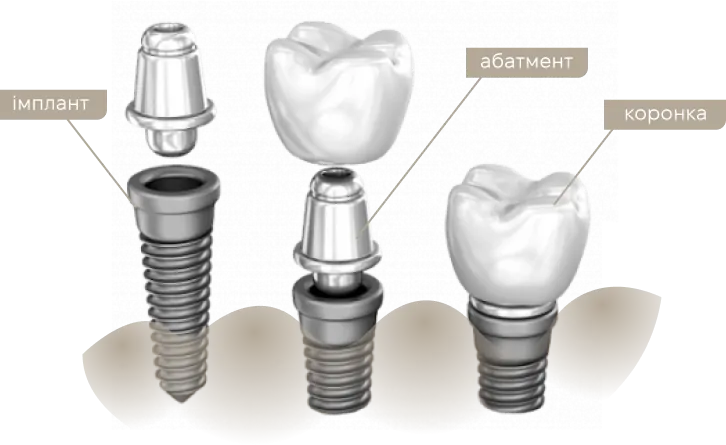
A dental implant itself is a titanium rod that is surgically inserted into the bone tissue and essentially performs the supporting function of the lost tooth (replacing its root). However, a restored tooth includes other components as well. An abutment is installed on the titanium rod itself. This is a mandatory connecting element - an adapter that is attached on top (essentially screwed) to the implant (titanium pin) and serves as the foundation for the dental crown. The prosthetic structure is fixed directly onto the abutment. In modern dentistry, two types of crowns are widely used for implantation - ceramic and zirconia crowns, which combine high aesthetics with durability.
What types of implants are available?
The dentists at our clinic follow international standards and protocols for dental implantation, adapting them to each individual case.
Classic two-stage dental implantation
Classical two-stage dental implantation involves removing the remnants of destroyed teeth, waiting for a period of healing of the tooth pit and restoration of the bone tissue, the second stage is the placement of the implant, and the third stage is the placement of the dental crown.
Implants for missing teeth (total adentia)
The complete absence of teeth (total adentia) requires special implant techniques, as all teeth must be restored.
At the DENTART Clinic we use the "All on Four" implant method, which involves the support of 4 implants on which a dental restoration is fixed. Other options: placement of 6 or 8 implants and a fixed bridge. Total (full implantation) is also possible - when the entire dentition is restored.
One-stage dental implantation
One-stage implantation is also called instant implantation. And this is true, because this implant technique involves inserting an implant immediately after the extraction of a destroyed tooth in the same visit.
The prerequisites for such an implantation are the absence of infection and inflammation in the oral cavity, matching the size of the hole to the implant and the availability of sufficient bone tissue.
Implantation of teeth without incisions (according to a surgical template)
Such implantation is also called transgingival. Before implantation, an individual model is made - a surgical template on which the future implant sites are marked.
The surgical template is fixed on the surface of the jaw, a puncture is made according to the size of the titanium root (implant) using the marked holes and it is placed in the correct, appropriate position.
Zygomatic 'Zygoma' Implantation
Zygomatic dental implantation involves inserting titanium rods not into the jawbone, but into the zygomatic (cheekbone) instead. This procedure is used for dental restoration in the upper jaw, and one of the main indications for this procedure is severe atrophy of the jawbone tissue (and the impossibility of using traditional implants). The procedure is performed without osteoplastic surgeries and waiting for healing (osseointegration). Zygomatic implantation uses a special Zygoma implant: it is longer and different in shape.
Customized implants
For complex clinical cases involving advanced bone resorption, our clinic offers an innovative solution—the Implantize Compact patient-specific implant. This custom device is designed precisely to your anatomy, which supports faster osseointegration and gold-standard reliability. It’s a smart choice when the success of conventional implant options is uncertain.
*There are indications and contraindications for each type of implantation, so the patient first undergoes an examination, is examined by an implantologist and is given advice on the plan and recommended method of implant placement.
Computer-guided dental implant planning
The stages leading up to implantation
- 01Diagnosis of the condition of the teeth and jawbonenecessary for the formation of an implant plan: location of the roots of the neighbouring teeth, bone thickness into which the titanium implant will be placed
- 02Treatment of decayed teeth in the mouthdue to an existing infection, the implant may not take
- 03Removal of the remains of destroyed teethif any
- 04Removal of dental depositstartar and plaque
These stages can be shortened or expanded, depending on the ascending condition of the teeth. Also, depending on the initial situation, various types of implants can be offered (according to materials, designs, manufacturers) and implantation programs (one- or two-stage).
What is needed for successful dental implantation? We believe that success begins with conversation, examination, implant planning and oral preparation..
So ask:
- can we install the implant right now?
- why do I need computer scans of my jaw?
- why do implants have different prices?
- what kind of crowns are there?
- who is the manufacturer of my implant?
- why treat caries of other teeth before implantation?
- why can't I chew with this tooth right away?
- so what if I don't have enough bone tissue?
- why do I need a follow-up examination, and my neighbor got a tooth in another clinic right away?
The specialists at the clinic have a different philosophy. The patient must understand what we do and why, because we are one team with a common goal!
We respond calmly to questions and are happy to answer and explain, because we know that when people understand each other, they act in harmony. Besides, we know our business, so we can answer even the most difficult questions.
Read in our doctors' blog - What you need to know before dental implantation
Stages of Dental Implantation
The implantation process itself, excluding preliminary diagnostics and preparation (for example, tooth extraction), includes the following stages:
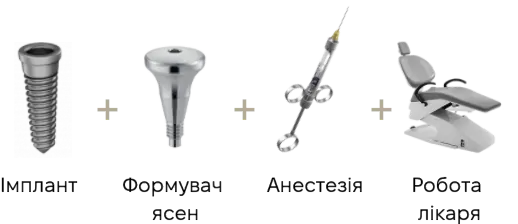
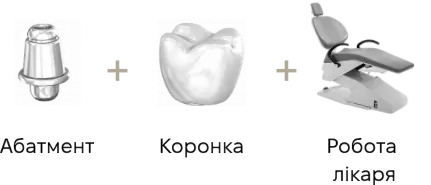
Dental Implants: Which System to Choose?
Our DENTART clinic in Kyiv uses only high-quality implant systems. They are distinguished by the use of biocompatible materials (primarily titanium), high success rates (98%+), and excellent overall manufacturer reputation. Our clients can choose the system that best suits their budget from the following options:
-
Straumann
One of the world's leading dental implant manufacturers from Switzerland. This system is positioned as premium. Therefore, the price for such a dental implant is quite high.
-
Nobel Biocare
Another Swiss premium dental implantation system. For clients in Kyiv, these titanium pins will cost slightly less than Straumann.
-
JDental
The Italian manufacturer JDental offers a wide range of dental implantation systems. At our DENTART clinic, we use this company's nasal and zygomatic dental implants.
-
BIOHORIZONS (USA)
Ankylos (Germany)
Anyridge (South Korea)Dental implants of these brands are positioned as mid-range solutions. They cost less than top Swiss systems but have also proven themselves as reliable and quality solutions.
-
Mega Gen (South Korea)
Neodent (Brazil)In the budget segment, our clinic in Kyiv offers relatively affordable but quality dental implants from these brands.
DENTART — a clinic with a guarantee on dental implants
Dental implantology is one of the core specialties at our Kyiv clinic. Our lead implant surgeons bring 25+ years of experience, with 32,000+ implants placed, thousands of successful cases, and countless satisfied patients. For you, that translates into the highest level of accountability, overall reliability, and a guarantee of success. We’re a clinic that guarantees the outcome of implant treatment. In 98–99% of cases, our implants integrate successfully; in the rare event of failure, we perform re-implantation at no charge.
We also use top-tier implant systems that carry long-term—and in the case of Straumann, lifetime—warranties. Choosing DENTART and our specialists means not only a successful implant procedure, but results designed to last a lifetime.
Indications for dental implantation are
- absence of one or more teeth;
- the absence of the last teeth in the row;
- absence of all teeth completely (due to congenital or acquired pathology, due to injury);
- allergic reactions to prosthetic materials;
- a collapsed bridge denture.
Contraindications for Dental Implantation
Consider such a situation: you found out that you can get an implant in place of your lost tooth, you went to the dentist, you are ready to be examined and treated, and you are already dreaming of a new tooth... But the dentist refuses to put an implant in your mouth. Is it possible?
Unfortunately, yes, there are cases where a patient may be denied an implant. You can be turned down in two cases.
Our team of specialists know how to take responsibility and assess the situation realistically.
We do not turn a patient away because their case requires more care or technicality and caution, but we also value everyone's life as our own.
Therefore, when we see that the risks of implantation are greater than the benefits, we offer other solutions.
Absolute contraindications to implantation.
- oncological diseases (severe stages, radiation or chemotherapy)
- blood diseases;
- mental illnesses.
Relative contraindications:
- Cardiovascular diseases (arrhythmias, hypertensive heart disease);
- A history of acute cardiovascular disease (heart attack, stroke);
- Diabetes mellitus;
- Viral hepatitis;
- Cancer (in remission);
- Patients with high risk of implant rejection (reduced immunity, poor tissue trophism);
- Elderly patients;
- Unsuccessful implantation in the past, the necessity of repeated implantation.
In these cases, implantation is technically possible, but there are high risks of complications, rejection of the implant. Implantation in these cases is considered complicated.
-
How is tooth implantation done?
A dental implant is the placement of a sterile titanium post into the bone of the upper jaw or lower jaw. It is usually done under local anesthesia and is much easier than tooth extraction.
-
How much will it cost to have all my teeth implanted?
An all-dental implant is a procedure to put 6 to 8 implants in or out. With immediate or delayed loading on the implants. The cost of the manipulation is calculated individually, depending on the chosen implant system. This is done in consultation with the surgeon-implantologist and the orthopedic surgeon. An individual treatment plan is drawn up, depending on the clinical situation in the oral cavity.
-
What is single-stage dental implantation?
One-stage implantation is the insertion of a dental implant into the extraction site immediately after the tooth is extracted. This procedure allows for a significantly shorter healing time of the implant, so a new tooth will replace the extracted one and appear much sooner. And also preserve all the parameters of bone in the area of the extracted tooth.
-
What is an implant abutment?
An implant abutment is a component of the implant, which is manufactured individually in a dental laboratory and the future tooth that will replace the removed tooth is placed on it (the abutment). This procedure is performed by the orthopedic dentist after taking imprints of the implant placed either in or out of the mouth.
-
Where is the best place to get a dental implant in Kyiv?
There are many clinics in the capital, but we recommend our own DENTART clinics in Kyiv. We provide comfortable, pain-free treatment, use high-end diagnostic equipment (including CT), and our experienced oral surgeons follow proven implant protocols and work with leading global implant systems. You’ll also receive individualized care and truly turnkey treatment with no hidden fees. Every patient has a dedicated care coordinator who reminds you about upcoming visits, answers any questions, and stays in touch.
-
How long does a dental implant procedure take?
The timeline depends on the treatment protocol. The surgical placement of a single implant usually takes 30–60 minutes. With immediate (one-stage) protocols, you can, quite literally, receive a new tooth in a single day (one visit). A classic two-stage approach—accounting for diagnostics, any necessary preparatory procedures (e.g., bone grafting), and the prosthetic phase (crown placement)—often takes about six months, sometimes longer.
-
Is getting a dental implant painful?
Implant placement is a surgical procedure, but thanks to modern anesthesia, treatment at DENTART is as comfortable and pain-free as possible. We use advanced anti-stress methods in dentistry, including local anesthesia, inhalation analgesia (nitrous oxide), and deep sedation (“sleep dentistry”).
-
How well is implant surgery tolerated?
Most patients tolerate implant surgery very well—sensations are often comparable to a tooth extraction. Pain is absent during the procedure and immediately after thanks to anesthesia. As it wears off, people typically experience only mild swelling and increased gum sensitivity around the implant site.
-
Can implants be placed under general anesthesia?
In theory, yes. However, in modern dental practice we prefer more gentle and safer methods of anesthesia. At DENTART we use local anesthesia, nitrous oxide inhalation analgesia, and treatment under deep (medication-induced) sedation.
-
Are dental implants safe?
At DENTART, implant treatment is as safe as possible. Procedures are performed by highly qualified, experienced implant surgeons and only after thorough diagnostics and assessment of any contraindications. We select the protocol best suited to each patient and use top-tier systems (e.g., Straumann, Nobel Biocare).
-
Can an implant be rejected?
It’s rare, but possible. In our experience, this occurs in fewer than 1–2% of cases and is usually related to individual physiology or not following basic post-op guidelines during healing. If you choose our services, you don’t need to worry: in the unlikely event of failure, we will perform re-implantation at no charge.
-
Why are implants better than dentures?
Implants outperform dentures in longevity, function, and aesthetics. They typically last a lifetime, handle chewing loads very well, and help create a flawless smile. Implants also prevent jawbone atrophy, support healthy gingival circulation, and are 100% biocompatible because they’re made of titanium.
-
How do dental implants differ from one another?
Implants vary by many criteria: design, surface texture, shape, and overall engineering. While materials once differed widely, titanium is now standard—though its quality can vary. Brands also differ in reputation, warranty commitments, and, as a result, cost.


