


Implantation without surgery (according to the surgical template)
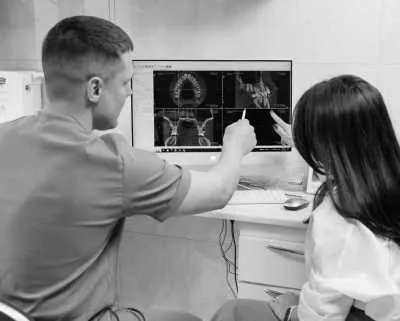
Dental implantation using a surgical guide is an innovative method of dental arch restoration that allows the procedure to be performed quickly, painlessly, and with minimal trauma. Through the use of 3D technologies and a custom template, implants are placed with maximum precision without the need for large incisions. A surgical guide for dental implantation is a custom template created based on a digital 3D scan of the jaw. It contains guide holes that ensure precise positioning of implants at predetermined angles, eliminating errors during placement.
We utilize all current dental implantation protocols in Kyiv, including guided implant surgery. Schedule a consultation with our implant surgeons: they will select the optimal method of dental restoration specifically for you.
Make an appointment
Benefits of Guided Implantation
The main advantages of guided implantation are speed and minimal trauma, as implant placement is performed through small punctures rather than traditional tissue incisions. Additional benefits of the procedure include:
- high precision (the template has holes that allow the implant to be placed at the required angle and avoid errors);
- accelerated healing period;
- reduced risk of complications, which, among other things, allows this implantation to be performed on patients with diabetes and similar conditions.
Price
- Initial surgeon-implantologist consultation950 UAH
- Consultation with leading oral surgeon-implantologist Ptichkina Y.O.2500 UAH
- Neodent implant placement (Brazil)12900 UAH
- JDental implant placement (Italy)13000 UAH
- Anyridge implant placement (Korea)17500 UAH
- Ankylos implant placement (Germany)19000 UAH
- Straumann BLX implant placement (Switzerland)22500 UAH
- Straumann Titanium implant placement (Switzerland)20000 UAH
- Straumann BLX SLActive implant placement (Switzerland)25500 UAH
- Nobel implant placement (USA)27200 UAH
- BIOHORIZONS implant placement (USA)21000 UAH
- Surgical guide planning and fabricationвід 3800 до 14000 UAH


Our doctors




Implantation
- Initial appointment with an implant surgeon
- One-stage implantation (immediately after tooth extraction)
- Two-stage (classical) dental implantation
- Implantation with complete absence of teeth (complete adentia)
- Zygoma dental implantation
- ALL-ON-4 implantation
- All-on-6 implantation
- Nobel Implants
- Straumann Implants
- Customized Implant Implantize Compact
What is a surgical template?
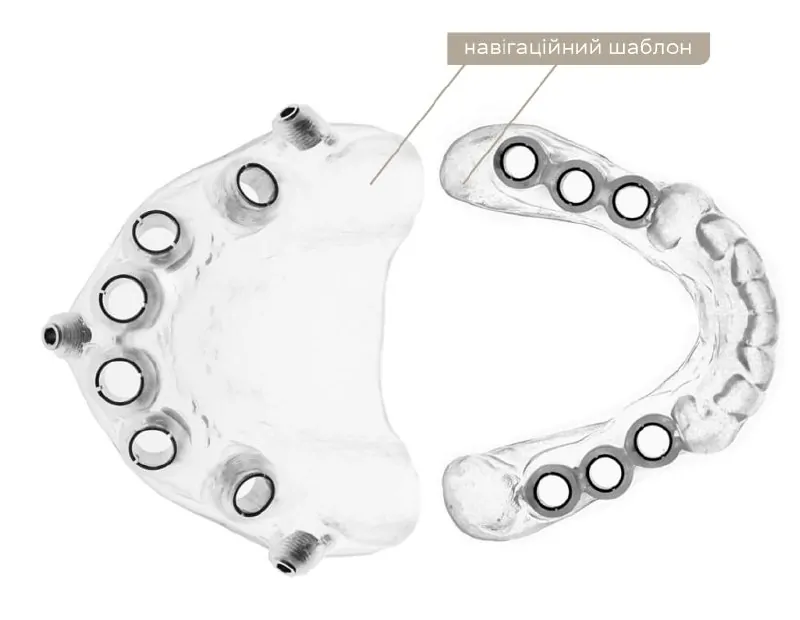
A surgical template is a model on which the future implantation site is marked as precisely as possible in the form of a hole. So precisely that the hole even has an individual degree of inclination (the angle at which the titanium implant root will be placed).
The surgical template has the form of a transparent coating that is firmly fixed on the surface of the jaw. It turns out that all the existing teeth will be closed with a template, and a hole will remain above the implantation site. It is in this hole that the implant will be implanted with a puncture. A puncture is still necessary, and it is several millimeters in diameter (corresponds to the diameter of the titanium root). But real incisions or suturing are not performed.
Indications for transgingival implantation
The indications are the same as for conventional implantation (absence of one or more teeth, adentia, destroyed bridge prosthesis).
And there are cases when implantation without incisions is most appropriate:
- in adentia (total absence of teeth, congenital or acquired), where a large number of dental implants need to be fitted immediately;
- in the case of anterior dental implants (when you want to get rid of a cosmetic defect as quickly as possible and place a crown on the implant immediately);
- if the patient has high anxiety about conventional implantation.
Stages of dental implantation using a surgical template
Contraindications to template implantation
There are contraindications to such implantation, but there are very few of them: severe cancer, blood diseases, mental illness.
This implantation is also not possible if there is insufficient bone (when the bone is atrophied and the titanium root has nowhere to be anchored). It is possible to identify on examination and pre-tissue grafting can be carried out.

-
Maximum precisionA CT-based surgical guide allows ultra-precise selection of implant position and angulation.
-
Minimally invasiveImplants are placed through tiny gingival punctures rather than conventional incisions.
-
Time-savingThe surgical phase and overall healing period are shortened.
-
Fewer risksGuided surgery is suitable for a broader range of patients, including those with diabetes.
-
Precision depends on the surgeon’s skillThe surgeon determines the incision site for implant placement.
-
Traditional procedureInvolves an incision and elevation of a gingival flap.
-
Typical durationPlacing a single implant takes about 30–60 minutes, with recovery of roughly 7–10 days.
-
Common contraindicationsNot performed in patients with cancer, diabetes, blood-clotting disorders, and other serious conditions.
-
How precise is guided implantation?
Using a surgical guide delivers benchmark accuracy, with minimal deviations in position (up to 0.1 mm) and angulation. Thanks to this precision, the titanium post can often be placed through a small pinpoint puncture instead of a gingival incision. Accuracy is one of the key advantages of template-guided implant placement.
-
Is guided implantation painful?
No—this is arguably one of the most comfortable options for patients. During surgery you won’t feel pain thanks to local anesthesia. The minimally invasive nature of the procedure supports faster recovery and reduces post-operative discomfort; most patients report only mild, short-lived gum tenderness that is manageable with pain relievers.
-
How much does digital (guided) implant placement cost?
Pricing is individualized and depends on the implant system used. The final fee also includes the design and fabrication of the custom guide; at DENTART this ranges from UAH 2,200 to 12,000. You’ll receive an exact treatment budget after a preliminary consultation with our implant surgeon.
-
Which is better—classic or guided implantation?
It depends on the clinical case. For example, with pronounced bone atrophy, digital guided surgery may not be indicated; in such cases, sinus lifting or other bone-grafting procedures followed by a conventional protocol are more appropriate—or even zygomatic (Zygoma) implants. If rapid smile aesthetics are a priority (e.g., loss of anterior teeth) or a patient prefers a less invasive approach, our specialists may recommend digital guided implantation.


