


Dental crowns in Kyiv
Dental crowns are prosthetic restorations that make it possible to rebuild even severely damaged teeth. At DENTART in Kyiv we use high-quality zirconia and ceramic crowns, offer digital scanning and a trial of your future smile, and our experienced prosthodontists take on even the most complex clinical cases. If you would like to restore full function to your teeth and enhance the aesthetics of your smile, we are here to help.
Make an appointment
Price
- Initial prosthodontist consultation950 UAH
- Comprehensive initial prosthodontic consultation (examination, CT scan, diagnostic digital scanning, consultation, treatment planning)2400 UAH
- Full-contour zirconia ceramic crown CADвід 10800 UAH
- E-max ceramic crown — framework with subsequent veneeringвід 15400 UAH
- Zirconia ceramic crown with porcelain layeringвід 12800 UAH
- Milled temporary crownвід 2350 UAH


Our doctors






What is a dental crown?
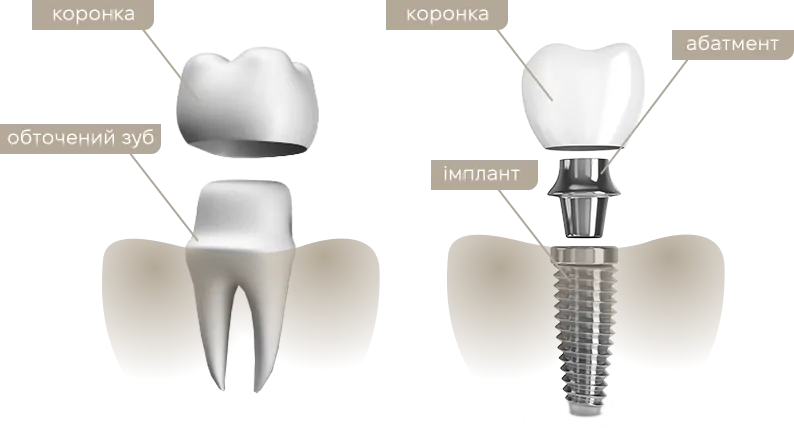
A dental crown is an orthopaedic structure that covers the visible part of the tooth like a cap. It is used in the case of severe destruction of the dental unit, when filling will no longer give good results (or they will be short-lived). A crown is also placed on a tooth after its extraction, for example, during implant prosthetics or as part of a bridge.
Types of dental crowns
- 01Ceramic (also known as all-ceramic)They consist entirely of ceramic and are manufactured in a dental laboratory by pressing or milling. The ceramic is characterised by excellent aesthetics, a decent level of strength and durability, and a reasonable price. This is an excellent crown for the front teeth.
- 02Zirconium crownsThese are crowns with zirconium oxide in the composition. This material is very strong (not inferior to metal), but at the same time perfectly biocompatible. Zirconium crowns can be solid or covered with ceramics that provide a reference aesthetic. The price of such crowns is higher than that of their analogues. Zirconium is an excellent choice for a chewing tooth crown.
- 03Metal-ceramic crownsThey have a metal frame covered with a ceramic layer. Previously, these were the most popular designs, but they gradually lost their positions. The main advantage is the affordable price of a crown. In terms of aesthetics and strength, they are inferior to more technologically advanced competitors.
Pros and cons of ceramic crowns
Advantages of ceramic crowns:
- Excellent aesthetics. The crown on the front teeth does not differ from natural units.
- The product is hypoallergenic and has excellent biological compatibility.
- The smallest thickness is 0.2 mm (allows you to reduce the preparation).
- Balance of price and quality.
- Durability is about 15 years.
The main disadvantage is that the strength is lower than that of competitors. Therefore, an all-ceramic crown is usually not placed on the chewing tooth.
Pros and cons of zirconium oxide crowns
Zirconium dental crowns have the following advantages:
- Durability up to 25 years.
- Reference strength. If you need a crown for a chewing tooth, then this is the best choice.
- The product is hypoallergenic and has excellent biological compatibility.
- Small thickness (about 1 mm).
- Excellent aesthetics of the crown on the teeth (when covered with ceramics).
The main disadvantage is the high price of a crown.
Pros and cons of metal-ceramic crowns
Advantages of metal-ceramic crowns:
- Affordable price.
- Good durability and reliability. This crown can be placed on a chewing tooth.
- Durability - 10 years.
Disadvantages of such structures:
- A sufficiently large thickness, which increases the volume of tissue to be prepared.
- Not the best aesthetic. A metal-ceramic crown for the front teeth is not the best choice.
- There is a risk of allergic reactions.
Zirconia crown vs ceramic crown

-
Service life of 20+ yearsZirconium dioxide is an extremely strong and durable material, so crowns made from it can last 20–25 years.
-
Optimal for posterior teethZirconia crowns are ideal for posterior (chewing) teeth. Designs with a zirconia framework and ceramic veneering are also suitable for anterior teeth.
-
Higher costMetal-free crowns are more expensive, as zirconia is a high-cost material.
-
100% biocompatibilityZirconia crowns do not provoke allergic reactions.
-
Less-than-perfect translucencyIn addition to their higher price, zirconia crowns are not as translucent as natural teeth. For the smile zone, zirconia frameworks with ceramic veneering are therefore recommended.
-
Suitable for patients with bruxismThe very high strength of zirconium dioxide helps minimise the risk of fractures and other damage in patients with bruxism and pathological tooth wear.
-
Less durable (10–15 years)All-ceramic crowns are not as strong and have lower resistance to fractures and other types of damage.
-
Best choice for the smile zoneAll-ceramic crowns are most suitable for anterior teeth, providing benchmark smile aesthetics.
-
More affordableAll-ceramic crowns are generally less expensive, although premium E-max restorations are only slightly cheaper than their zirconia counterparts.
-
100% biocompatibleAll-ceramic crowns do not cause allergic reactions; such issues are seen only with porcelain-fused-to-metal restorations.
-
Lower strengthAll-ceramic crowns are less strong and are generally not intended for intensive chewing loads.
-
Best avoided in bruxismIn cases of involuntary night-time grinding, all-ceramic crowns are not recommended due to their lower wear resistance and higher risk of fractures.
What type of crown to choose?
Crown vs filling
Both fillings and crowns can be used to restore teeth. The indication for each option depends on the extent of destruction of the tooth structure. For small defects, a filling may be sufficient, whereas in cases of extensive damage a crown is usually the more appropriate solution. These types of restorations differ in many aspects — materials, service life, cost and the method of placement. In the past, there were many situations where dentists placed large fillings even in severely compromised teeth, including after endodontic treatment; today, modern dentistry far more often prefers crowns, which are significantly superior in terms of reliability and long-term prognosis.
A filling is typically placed in a single visit, whereas crowns are fabricated in a dental laboratory, so at least two appointments are required. During the first visit the tooth is prepared and a digital scan is taken. Using advanced techniques (including CAD/CAM technologies), dental technicians then fabricate the crown. Once it is ready, the patient returns to our clinic for the try-in and final cementation. Additional stages may also be required, including post placement, a trial of the future smile and any necessary therapeutic treatment.
Filling is a relatively quick and cost-effective type of restoration and may be the optimal choice in cases of minor tooth damage. In situations involving significant destruction of the tooth structure, following endodontic treatment, or when there are clear indications for extraction, it is recommended to opt for reliable, long-lasting crowns.
-
Made of compositeManufactured from a biocompatible composite material that generally does not cause allergic reactions.
-
Moderate service life and strengthThey last around 5–10 years and have relatively low resistance to staining and chipping.
-
Suitable for minor defectsUsed to restore mildly damaged posterior teeth and small defects (chips) in anterior teeth.
-
Cost-effectiveRestoration with fillings is more affordable.
-
Aesthetic and longevity limitationsOver time, the appearance of fillings deteriorates; they are prone to chipping and other damage, and secondary caries may sometimes develop underneath.
-
Made from different materialsZirconia and all-ceramic crowns are 100% biocompatible and hypoallergenic, whereas metal-ceramic (porcelain-fused-to-metal) crowns do not eliminate the risk of allergic reactions.
-
More durable and strongerThey can last from 10–15 up to 25 years. The exact lifespan depends on the material, with zirconia crowns being the most long-lasting option.
-
More versatileCrowns are the best choice in cases of moderate to severe tooth damage. If a tooth needs to be extracted, a crown can also be placed on an implant.
-
Higher costCrowns are fabricated in a dental laboratory, which increases the overall cost of treatment.
-
More complex placementPlacing a crown requires at least two visits to the prosthodontist. Preparation also involves tooth reduction — the removal of a significant amount of the outer tooth structure.
How is a crown better than a filling?
When restoring teeth in modern dentistry, the choice is often between a filling or a crown. How is orthopaedic construction better than composite materials? Here are the main advantages:
- A crown protects preserved tooth tissue from damage, while a filled tooth does not prevent further decay.
- The crown on the teeth has the correct shape and performs chewing functions properly.
- The crown fits perfectly to the tooth and does not shrink. In contrast, a filling shrinks over time, becomes more visible, and causes the risk of secondary caries.
- A dental crown, especially one made of ceramic, has a look that is indistinguishable from natural tissues not only in terms of colour but also in terms of transparency and light transmission. Besides, such aesthetics lasts for the entire service life, while a filling dark with time.
- A crown on a tooth lasts for 10+ years, while fillings have a much shorter lifespan.
It should be noted that in case of relatively minor tooth tissue damage, other orthopaedic structures, including ceramic onlays, can be used in addition to the crown. They are more affordable than crowns, but have almost the same advantages as fillings.
How is a crown placed on a tooth?
Usually, it takes 2 visits to our clinic to place a crown on a tooth. That's because the design itself is made in a specialised dental laboratory based on imprints. The entire procedure for restoring dental units with crowns includes the following steps:
- Preliminary consultation. The doctor will examine the oral cavity, determine the appropriate design, and tell you how much the crown costs.
- Preparation. At the very least, a preparation is required, i.e. the removal of a layer of tooth tissue to the thickness that the crown will occupy. Sometimes other dental procedures are also required, such as occupational hygiene, root canal treatment, etc.
- Taking an imprint for making a crown in the laboratory.
- Placement of a temporary orthopaedic structure.
- Fitting the finished crown on the tooth.
- Fixing the crown with a special dental cement.
When a crown is placed on the front teeth, you can first use the Digital Smile Design service of digital modelling and fitting of your future smile. And if implant prosthetics is performed (in the absence of a tooth or its severe decay and indications for extraction), the procedures described above are preceded by tooth extraction and implantation.
Indications and contraindications
- severe decay (more than 50% of the crown);
- severe aesthetic defects with contraindications for veneers or other restorations;
- tooth loss (implant prosthetics or bridges are recommended).
Dental care after crown placement
- brushing teeth twice a day;
- regular use of dental floss, brush and/or irrigator;
- use of mouthwash; reduction of mechanical stress on ceramic crowns;
- regular visits to the dentist and performing professional hygiene twice a year.
Care of implant-supported crowns
The main differences in home care after implant-supported prosthetics relate to paying extra attention to the condition of the soft tissues around the titanium implants. As a rule, it is better to switch to a toothbrush with soft or medium bristles. In addition to regular flossing, it is recommended to clean the interdental spaces with special interdental brushes or an oral irrigator. This helps reduce the risk of inflammatory processes. After implant placement, it is also highly advisable to give up smoking. In fact, this recommendation is relevant for all types of prosthetic treatment, as cigarettes are extremely harmful for the teeth, oral cavity and overall health.
Any other questions? Call us or make an appointment with an orthopaedic dentist on the website!
-
Which dental crowns are the best option?
The most appropriate type of crown is determined individually, taking into account a range of factors. For example, zirconia crowns are usually the best choice for posterior (chewing) teeth, as they cope very well with high loads and can last for more than 20 years. For teeth in the smile zone, ceramic crowns or zirconia crowns with ceramic veneering are recommended. They provide benchmark aesthetics. It is also important to consider your budget, as some options are more affordable while others (such as zirconia) are more expensive. The optimal solution for your specific needs and possibilities will be recommended by your DENTART prosthodontist after a comprehensive consultation and any necessary diagnostics.
-
Is it painful to have a crown fitted?
No, having a crown placed is not painful, because we use anaesthesia during potentially uncomfortable stages of prosthetic treatment (such as tooth preparation). As a rule, local anaesthesia is used, and if indicated, other modern anxiety-control methods can also be offered. Any discomfort is also minimised at the impression stage: in DENTART we do not use traditional impression materials for crown fabrication but instead take a digital impression.
-
Which crowns are the strongest?
The strongest crowns are those made from zirconium oxide (zirconia). Zirconia crowns cope excellently with all chewing loads and are therefore recommended for restoring posterior teeth. They are highly resistant to chipping and wear and can last up to 25 years. Metal-ceramic (porcelain-fused-to-metal) crowns rank second in terms of strength; however, they are inferior to zirconia in longevity and aesthetics, while being more affordable in terms of price.
-
Which crowns are best for front teeth?
For anterior teeth, ceramic crowns or zirconia crowns with ceramic veneering are usually recommended. Ceramic allows you to achieve the best possible smile aesthetics, closely imitating the natural colour, shine and translucency of real teeth. All-ceramic crowns for front teeth are less expensive than zirconia, but they are somewhat inferior in strength and overall longevity. Which option is best for you personally will be determined by your DENTART prosthodontist after a comprehensive consultation, which includes all necessary diagnostics (CT and other examinations).
-
Which crowns should I choose for molars / chewing teeth?
For posterior (chewing) teeth, the choice of crown should prioritise high strength and durability. The best modern solution in this regard is zirconia-based prosthetic restorations. They are highly resistant to wear, chipping and other damage and can last up to 25 years. From an aesthetic standpoint, they are also more than adequate; given that these teeth are outside the smile zone, additional ceramic veneering is not strictly necessary. For patients with a limited budget, metal-ceramic crowns may be considered, but it is important to understand that they are noticeably inferior to zirconia in key performance characteristics.
-
Do I always need a root canal (nerve removal) before getting a crown?
No, removing the pulp (the so-called “tooth nerve”) is not always required when placing a crown. In the past (when thicker porcelain-fused-to-metal and other outdated types of prostheses were used), depulpation was often recommended, because extensive tooth reduction could lead to significant heating and subsequent damage to the pulp. Today, ceramic and zirconia crowns are much thinner, so the amount of tooth structure that needs to be removed is minimal. The nerve only needs to be removed if the tooth is already compromised — for example, in cases of deep caries, diagnosed pulpitis or periodontitis, or other indications for endodontic treatment. This is why high-quality diagnostics always precede prosthetic treatment at DENTART.
-
How long do dental crowns last?
The longevity of crowns depends on the material and on how carefully you follow the key aftercare recommendations. Zirconia crowns generally last the longest — up to 20–25 years. The average service life of ceramic restorations is around 10–15 years (these timeframes apply primarily when ceramics are used on anterior teeth). Metal-ceramic crowns on posterior teeth typically last about 10 years.
-
How should I care for my crowns?
Home care for crowns is almost the same as for natural teeth. You should brush twice a day and use dental floss or interdental brushes to remove plaque and food debris from between the teeth. An oral rinse and irrigator can also be helpful. To extend the lifespan of your crowns, it is advisable to limit very hard foods such as nuts and crackers. To avoid issues with staining, you should also moderate your intake of highly pigmented drinks such as coffee, tea, red wine and sugary coloured sodas. On average, a dental check-up and professional hygiene are recommended every six months.
-
Can I get a crown if I have diabetes?
Diabetes mellitus is not an absolute contraindication to crown placement. However, this diagnosis does impose certain limitations on dental treatment. Successful prosthetic rehabilitation (including implant-supported restorations) requires coordinated work between the dental team and the patient’s endocrinologist. A crown should only be placed if the condition of the oral cavity is satisfactory (or has been improved with appropriate treatment) and the disease is well controlled, with stable blood sugar levels. It is also worth noting that patients with diabetes are generally advised to choose zirconia or all-ceramic crowns — without metal components, which may increase the risk of allergic reactions.
-
From what age can crowns be placed?
Modern dentistry does not impose strict age limits on crown placement. When indicated (for example, in cases of trauma or advanced caries), prosthetic treatment can be performed in children of various ages, including crowns supported by primary (baby) teeth. This approach can help reduce the risk of malocclusion, promote proper distribution of chewing forces and prevent aesthetic issues in children. Specific recommendations on whether a child or teenager needs crowns will be provided by our prosthodontists after a comprehensive examination and full diagnostic work-up.


