


Prosthetics on implants in Kyiv
Prosthetics on implants —implants) is the most aesthetic and progressive method of restoring one or more lost teeth. Besides, such implantation also allows you not to use removable dentures, which solved complete adentia (loss of the entire dentition).
If you are interested in implant prosthetics in Kyiv, please contact the dentists at DENTART Clinic. We will ensure your smile looks flawless, and the procedure itself is painless and comfortable for you.
Make an appointment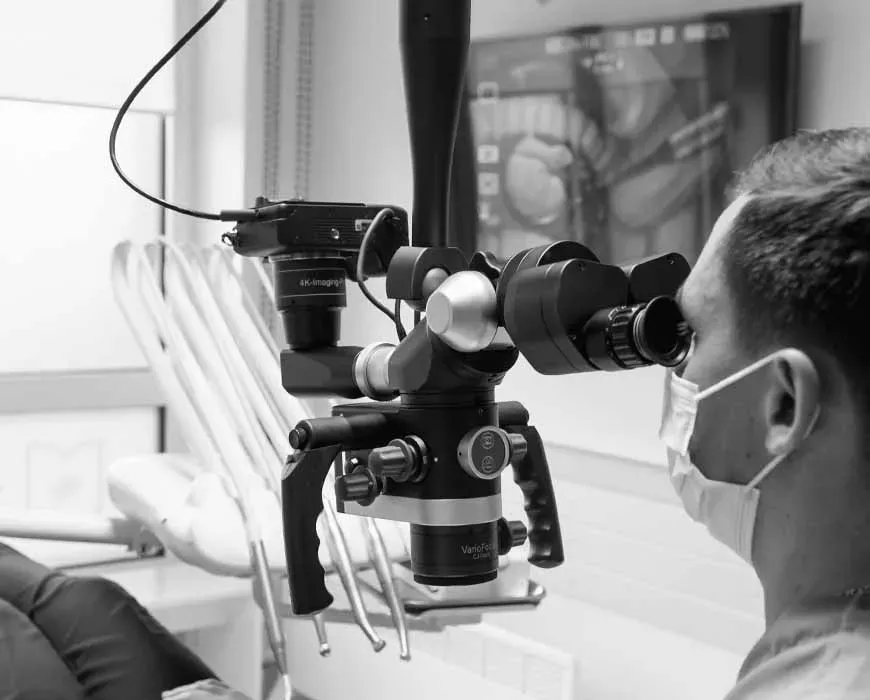
Рrosthetics on implants in DENTART
- Our specialists are experienced implant and prosthodontist professionals who guarantee high-quality procedures and perfect aesthetics for your smile.
- We carry out all the preparatory procedures, including diagnosis with a CT scanner, which will provide three-dimensional images of the mouth and allow you to assess the current condition of your teeth and gums.
- We use all modern types of implantation, including placing implants immediately after a tooth extraction, followed by immediate loading. In doing so, we rely on gentle techniques for your maximum comfort and a quick recovery period after surgery.
- We guarantee a beautiful smile: after our work, your restoration will be indistinguishable from your real teeth.
- We use magnification to treat teeth with maximum precision.
- We use anti-stress techniques, including sleep surgeries, to ensure that all procedures go as quickly as possible for you.


Our doctors






Implant prosthetics: what is the point of restoring lost teeth
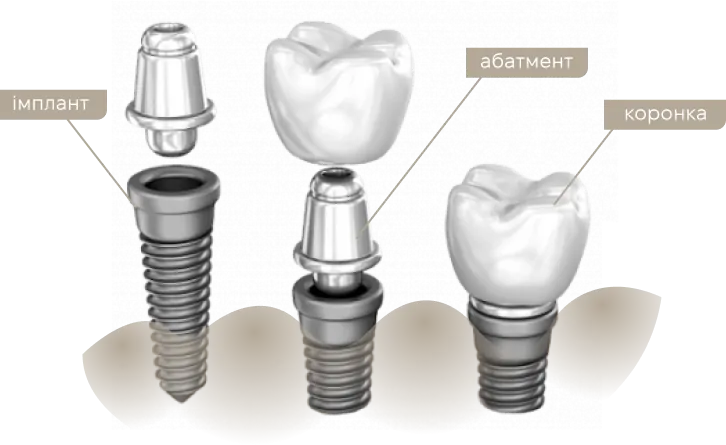
In fact, the implant is an artificial root. It is usually made from a titanium alloy, which is characterised by maximum strength and biocompatibility. The essence of this method boils down to:
- an artificial titanium root is implanted into the jawbone in place of the missing tooth, and bone grafting is carried out;
- it is then given time to take root;
- a special adapter, the abutment, is then fitted to the titanium rod;
- a crown is then attached to this adapter, which completes the restoration of the tooth.
When is implant prosthetics used?
Implantation followed by placement of prosthetic constructions or dentures on the artificial root is used in the following situations:
- if one tooth is missing. Here, a crown is placed on the implant. This recovery option is the most effective and reliable;;
- if you have lost several teeth. In such a situation, various options are possible. First, several artificial roots can be put in when teeth are lost both in different places in the mouth and next to each other. Second, an implant-supported bridge is also possible, which is considered a more secure and durable solution than a bridge supported on neighbouring teeth;
- with complete adentia (loss of the entire dentition). Not so long ago, in a similar situation, it was possible to use only removable dentures on suction cups. But modern dentistry does not stand still. Today, it offers various implantation options, including All on 4 or All on 6 or All on 8 technologies. In this case, respectively 4, 6 or 8 titanium roots are implanted in each jaw, and a fixed, conditional or removable denture is then fitted. The choice of option is left to the doctor, who considers each individual case and the medical conditions available. This type of restoration not only ensures a beautiful smile and the ability to chew food normally, but also has an excellent rejuvenation effect for 10-15 years.
What crowns are used after implantation?
At DENTART Clinic in Kyiv, we use high-end crowns with two key requirements - maximum aesthetics and a high level of durability. With this approach, your restored tooth will last a long time and be indistinguishable from your real tooth. In time, you yourself will forget exactly where it is in the dentition.
We fit such types of crowns:
- ceramic and zirconia (these two types can be placed in the same row, they have almost identical descriptions). We use them most often because of their great appearance and high durability. Thanks to their translucency, they are indistinguishable from real teeth. In addition, ceramics and zirconia are not foreign to the body and do not darken over time, as they are not susceptible to colour pigments. Ceramic and zirconia crowns are recommended for restoring anterior teeth (in the smile area), but they are also excellent for chewing teeth;
- metal-ceramic. They are more reasonably priced, but are still very durable. Metal-ceramic crowns can be used in situations where chewing teeth are being restored;
- temporary. They are inserted for a short period until, for example, permanent crowns are made or the period necessary for the implant to take full effect has passed. They are made from photopolymers, plastics and other materials.
Crowns on implants: zirconia vs E-max ceramic

-
Superior strength and longevityThey withstand heavy functional loads and can last more than 20 years.
-
Versatile optionZirconia crowns are suitable for implant-supported restorations on posterior (chewing) teeth, and when veneered with ceramic, they are also appropriate in the smile zone.
-
Good aestheticsIn terms of colour and shape, zirconia provides a good imitation of natural enamel.
-
Zirconia translucency is not idealIts translucency differs from that of natural enamel, but ceramic veneering makes it possible to achieve near-“perfect” aesthetics.
-
Strong and reliableE-max crowns are slightly less strong than zirconia and typically last around 10–15 years.
-
For anterior teethFull ceramic E-max crowns are well suited for implant-supported restorations on anterior teeth.
-
Benchmark aestheticsE-max ceramic crowns offer excellent, highly natural-looking aesthetics.
-
The abutment may show throughThe high translucency of ceramic can make a metal abutment visible, in which case a hybrid or zirconia abutment is recommended instead.
How long do implant prosthetics take?
Classic implantation (two-stage) always guarantees the desired result, but it is not fast in terms of time either. It can take several months to six months between the implantation of an artificial root and the fitting of a fixed denture.
Оne-stage procedure - when a prosthesis on implants is installed immediately after implantation. An implant is placed in one visit, and a temporary crown is placed on it. After a while, a permanent one replaces it. Our dentist will decide whether this option is suitable for you at a personal appointment after an additional examination.
Stages of implant-supported prosthetic treatment: from consultation to crown
Implant-supported prosthetic rehabilitation is a complex process that consists of several key stages. Conventionally, they can be divided into: diagnostic and preparatory work, extraction of teeth (if required), the implant placement itself, and finally the prosthetic phase — placement of crowns, bridges or other restorations.
At DENTART, we offer full “turnkey” implant treatment. This means that a personal treatment coordinator is assigned to you and stays in touch throughout the entire process. You will know the final cost of treatment before it begins, and there are no hidden charges.
If you wish, before implant-supported prosthetic treatment we can also provide digital smile design and a “try-in” of your future smile. The Digital Smile Design (DSD) service allows you to see in advance how your teeth and smile are expected to look at the end of treatment.
Care for implant-supported restorations
Basic daily care for implant-supported restorations is very similar to home hygiene for natural teeth:
- brush your teeth at least twice a day;
- use dental floss to clean interdental spaces;
- have professional hygiene performed at our clinic every six months.
After prosthetic treatment on implants, proper home care of the soft tissues (gums) around the titanium implants becomes even more important. In this regard, it is generally advisable to:
- switch to a soft (or medium-soft) toothbrush;
- use not only dental floss but also additional interdental cleaning aids such as an interdental brush or an oral irrigator;
- give up harmful habits, including smoking.
Advantages and disadvantages of implant-supported restorations
Advantages of implant-supported restorations:
- Reliability and longevity. Dental implants usually last a lifetime, while the prosthetic restorations on them can serve for more than 20 years.
- Excellent aesthetics and full chewing function. Implant-supported restorations provide full functionality — they are ready for normal chewing loads and ensure a beautiful, natural-looking smile.
- Prevention of bone atrophy and gum problems that typically occur after tooth loss and when using removable dentures.
- Preservation of neighbouring healthy teeth. Without implants, replacing a single missing tooth often requires a fixed bridge, which in turn involves preparation (drilling) of healthy adjacent teeth.
- Maximum comfort. Implant-supported restorations are cared for just like natural teeth. There is no need to remove anything, and there is no risk of displacement, loosening or accidental loss of the prosthesis.
Disadvantages of implant-supported restorations:
- The need for surgery. Implant placement is a surgical procedure, and there may be contraindications to it.
- Higher cost compared to traditional prosthetic options.
- Additional procedures may be required, such as bone grafting surgeries in cases of pronounced jaw bone atrophy.
-
What is the difference between a zirconia crown on an implant and an E-max ceramic crown?
These prosthetic restorations differ in their materials, manufacturing techniques and key performance characteristics. A zirconia crown is produced by milling. It is the strongest and most durable option and is the best choice for restoring the chewing function of teeth. An E-max ceramic crown is manufactured by pressing and is impeccable from an aesthetic point of view, reproducing not only the colour and shape, but also the translucency of natural enamel.
-
Can the metal abutment show through an implant-supported ceramic crown?
Yes, the metal abutment can sometimes be visible through a ceramic crown. This is due to the semi-translucent nature of the ceramic and the darker colour of the metal. In the smile zone, this may have an undesirable aesthetic effect. To avoid this, at DENTART we use either zirconia or hybrid (combined) abutments for implant-supported restorations in the anterior region. Hybrid abutments have a titanium base with a ceramic or zirconia upper part, which eliminates the risk of metal shine-through.
-
What is better for a front tooth on an implant: zirconia or E-max?
For a front tooth, there are two “gold standard” aesthetic options: an all-ceramic pressed crown (E-max), and a zirconia crown with ceramic veneering. A crown made entirely of zirconia is not ideal for the smile zone, as it does not provide the same level of translucency as natural enamel. Which type of crown will be the best solution for your anterior tooth can be determined after an in-person consultation with a DENTART prosthodontist.
-
Which crowns are the strongest for implant-supported restorations in the posterior (chewing) region?
For restoring posterior teeth and ensuring full chewing function, zirconia crowns on implants are recommended. Zirconia is 100% biocompatible and does not cause allergic reactions (unlike metal-ceramic restorations). It offers the highest strength and durability, with a service life of over 20 years. Zirconium dioxide easily tolerates intensive chewing loads, can be used even in patients with bruxism, and maintains its original appearance throughout its service life.
-
Are crowns on implants different from crowns on natural teeth?
In terms of appearance, materials and function, crowns on implants are essentially the same as crowns supported by natural teeth. The key difference lies in the method of attachment. To place a crown on a natural tooth, the tooth must be prepared — this may include therapeutic treatment (if needed) and reduction of the tooth structure (tooth preparation). To attach a crown to an implant, a special connector called an abutment is used. It acts as an intermediate element between the titanium implant and the prosthetic restoration.
-
Is it possible to place a metal-ceramic crown on a Nobel Biocare implant?
Yes, this combination can be used to restore one or several missing teeth, and it is technically acceptable. However, from a practical standpoint, it is not the most balanced solution. When a premium implant system is used (and Nobel Biocare belongs to the high-end segment), it is more reasonable to choose advanced prosthetic options as well — specifically, zirconia crowns. Compared to metal-ceramic restorations, they provide superior aesthetics, strength and longevity.
-
Which abutment is better for aesthetics under an E-max crown: ceramic or titanium?
From an aesthetic point of view, ceramic abutments are preferable under E-max crowns. A titanium abutment may show through the ceramic, causing the restoration to look different from the neighbouring natural teeth. To avoid these risks, we recommend ceramic, zirconia or hybrid abutments. A hybrid abutment consists of a titanium base and an outer layer of zirconia or ceramic.
-
After how many years does a crown on an implant need to be replaced?
The service life of an implant-supported crown depends primarily on the material: modern all-ceramic crowns generally last 10–15 years; zirconia crowns can last 20–25 years; metal-ceramic crowns usually serve for around 10 years.
-
Can an old crown on an implant be replaced without replacing the implant itself?
Yes. If the crown is damaged or has reached the end of its service life, only the prosthetic restoration needs to be replaced. The titanium implant itself usually remains unchanged, so repeat implant surgery is not required. However, before placing a new crown, our DENTART doctor will always check the condition of the implant and surrounding tissues.
-
Why is a crown on an implant more expensive than a crown on a natural tooth?
The crowns themselves are similar in price. However, treatment with implants is typically more expensive because it includes the implant surgery. This is a complex surgical stage involving the placement of an artificial tooth root — a biocompatible titanium implant. In addition, tooth extraction or bone grafting may be required before implant placement. Another cost factor is the abutment, which is always used in implant-supported prosthetics as a connector between the implant and the crown.
-
What is the difference between a standard and a custom abutment?
A standard abutment is a prefabricated, mass-produced component available in a limited range of shapes and sizes. It does not always take into account the individual anatomy of a patient’s gums and bone. A custom abutment is designed and manufactured specifically for an individual case. It is tailored 100% to the patient’s anatomical features and provides an optimal fit and emergence profile.
-
Can an abutment be changed without removing the implant?
Yes, the abutment can be removed while leaving the implant in place. It is a separate component typically attached with a screw, which the dentist can unscrew using special instruments. This design feature allows the selection or replacement of an abutment that better matches the patient’s bone and soft-tissue anatomy and provides the desired angulation.
-
How many implants are needed for a three-unit bridge?
To place a three-unit bridge restoring three missing teeth, two implants are required. In this case, the titanium implants serve as supports at each end of the bridge.
-
Is it possible to make a bridge supported by both an implant and a natural tooth?
This type of prosthetic solution is considered a compromise, suboptimal and often quite risky. When a bridge is supported by both an implant (or implants) and natural teeth, the load is distributed unevenly. This increases the risk of damage to the bridge and to the supporting natural teeth. In cases of root fractures or other serious problems, such teeth may eventually need to be extracted.
-
How long does an implant-supported bridge last, and when does it need to be replaced?
An implant-supported bridge can generally last more than 10–15 years. For example, zirconia bridges have very high strength and may serve for over 20 years. The timing of replacement depends on the material used and the clinical condition in each individual case. Adhering to our dentists’ recommendations and maintaining good oral hygiene are key factors for prolonging the lifespan of the bridge.
-
Why is a temporary crown on an implant needed, and how long is it worn?
A temporary crown on an implant is placed primarily for aesthetic reasons, so that the absence of a tooth is not visible. It also protects the gums and helps to shape a natural contour around the future restoration. Temporary crowns are usually worn for 2 to 6 months — this corresponds to the typical period of implant osseointegration.
-
What is the maximum time a temporary crown can be used on an implant?
As a rule, temporary crowns are not intended to be used for more than 6 months. This is approximately how long it takes for the implant to integrate with the bone, after which the final prosthetic restoration can be placed. If, for any reason, it is not possible to complete implant prosthetics within 6 months, we at DENTART usually replace a worn temporary crown with a new one of the same type.


