


Metal-free crowns (zirconium)
Zirconia crowns are one of the most progressive dentures of the 21st century. They meet the highest demands in terms of durability and aesthetics and can accurately imitate the natural tooth substance, its colour and shine. These crowns do not contain metal (hence the name metal-free), which makes them harmless and hypoallergenic.
If you would like to get a zirconia crown in Kyiv, please contact the dentists at our DENTART Clinic. Our doctors are experts in aesthetics and regularly use metal-free crowns in their work. These prosthetic constructions can be fitted either on implants or on your own teeth. In the latter case, we will definitely take care of the most gentle preliminary preparation.
To find out more details, contact our consultants or book an appointment on our website.
Make an appointment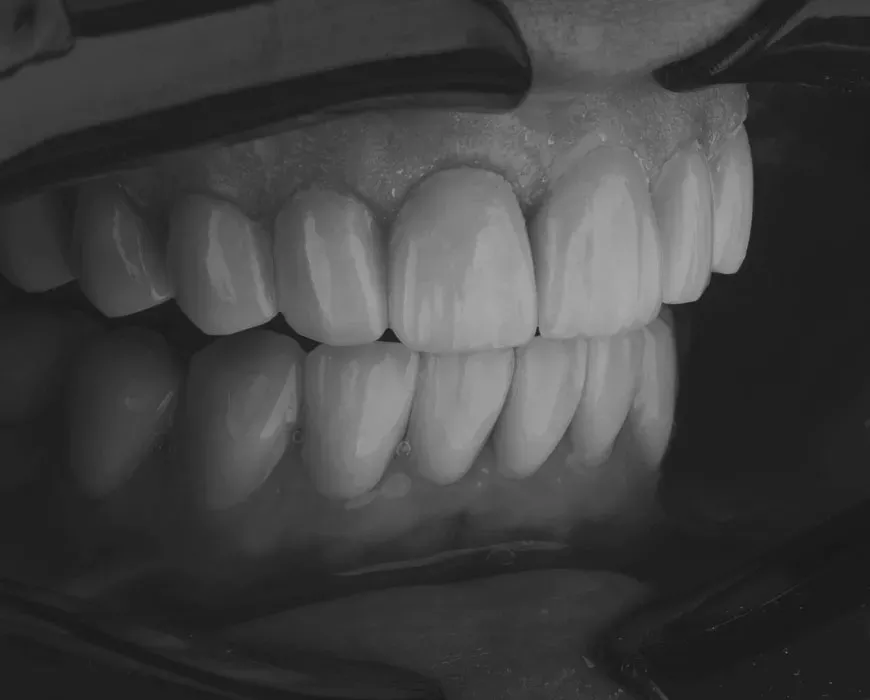
Price
- Initial prosthodontist consultation950 UAH
- Comprehensive initial prosthodontic consultation (examination, CT scan, diagnostic digital scanning, consultation, treatment planning)2400 UAH
- Full-contour zirconia ceramic crown CADвід 10800 UAH
- Zirconia ceramic crown with porcelain layeringвід 12800 UAH


Our doctors






Zirconia crowns: key features and varieties
Zirconium dioxide is among the modern bio-ceramic materials used to create crowns. It is extra hard and durable, but is also characterised by high aesthetic qualities, allowing you to count on a natural and beautiful smile.
This crown requires a high-tech process in which a prefabricated model is created from a blank, which perfectly corresponds to the impressions made for each individual patient. Importantly, zirconia crowns are lightweight and thus do not have any unwanted impact on the teeth, not even when used as part of a bridge, which is an active part of the masticatory function.
Metal-free crowns can be used on all teeth, including those in the smile zone.
There are two main types of such crowns:
- whole. They consist only of this bio-ceramic material and do not provide additional coatings. They are used to restoring lateral (masticatory) teeth, for which high mechanical strength is extremely important. They are not suitable for anterior teeth because they do not have the natural translucency that is typical of natural enamel;
- with an additional ceramic coating. These are the perfect crowns for the smile zone. A thin ceramic layer applies to the zirconium dioxide or cast silicate basrestoree (Emax), which has the level of translucency. After the bonding process is completed, the ceramics are tinted to match the colour of the patient's enamel, shades are applied, and polishing is performed.
Zirconia crowns are used for restorations of a single tooth or complete edentulism, implant prosthetics, metal allergies, and when alternative options are contraindicated.
Zirconia crowns for front teeth
Zirconia crowns are suitable for restoring teeth in the smile zone. It is important to note, however, that zirconium dioxide itself does not possess the same natural translucency as tooth enamel. For this reason, anterior restorations are fabricated as bi-layer (two-component) prosthetic constructions. A high-strength zirconia framework serves as the base, onto which a special ceramic layer is applied. This veneering layer provides the required level of translucency. It is then shade-matched to the patient’s natural enamel colour and, to achieve benchmark aesthetics, is further characterised with individual shading and finished with high-gloss polishing of the outer surface.
Modern aesthetic dentistry can therefore recommend not only all-ceramic but also zirconia crowns for anterior teeth. Zirconia-based restorations offer superior overall strength and longevity, although they are more expensive. Which option will be optimal in your case is something your prosthodontist at DENTART will determine after a comprehensive initial consultation.
Zirconia crowns for posterior teeth
Zirconium dioxide is an extremely strong material, which allows the crown to be made very thin (around 1 mm) while still easily withstanding all chewing loads and other mechanical forces on the molars. For posterior (lateral) teeth, DENTART in Kyiv recommends using monolithic zirconia crowns. They are made entirely from this high-strength material and do not require any additional veneering layers. As a result, such restorations are highly resistant to chipping, cracking and other types of damage.
Given all these advantages, zirconia crowns can be used to restore posterior teeth even in patients with bruxism (involuntary night-time grinding). Using ceramic or metal-ceramic alternatives in such cases increases the risk of fractures and chipping of the ceramic layer.
Zirconia crowns on implants
When choosing implant-supported restorations, patients naturally expect not only to regain full function and aesthetics of the dentition, but also to maintain these results for many years. That is why, at the prosthetic stage — when crowns or other restorations are placed — zirconium dioxide constructions are often the most reasonable choice. Like titanium, zirconia is a completely biocompatible material that does not trigger allergic reactions. In addition, zirconia crowns are characterised by very high strength and exceptional longevity, with a service life that can exceed 20 years.
Additional advantages of zirconia crowns on implants include:
- Versatility. Zirconia is ideal for restoring posterior teeth, while zirconia crowns with a ceramic veneering layer are perfectly suited for anterior teeth.
- Stable shape and colour. Zirconia is highly resistant to mechanical damage, wear and staining from food dyes. As a result, zirconia crowns on implants maintain impeccable aesthetics throughout their entire service life.
- Digital 3D planning. The use of digital 3D modelling ensures not only exceptional precision of implant placement and crown fit but also additional benefits, such as the ability to preview and “try on” your future smile even before treatment begins.
Zirconia crown vs E-max
Zirconia crowns differ from E-max prosthetic restorations not only in the material used (E-max crowns are made from pressed glass-ceramic). They also have different fabrication workflows and performance characteristics.
For posterior teeth, zirconia crowns are definitely the priority choice. For restorations in the smile zone, both E-max crowns and zirconia-based restorations with ceramic veneering are suitable. Which option will be best for you personally will be determined by our DENTART prosthodontist after a comprehensive initial consultation, which includes all necessary diagnostics, such as CT imaging. Compare zirconia crowns and E-max crowns:

-
Made of zirconium dioxideZirconia crowns are milled from a solid block of zirconium dioxide, a 100% biocompatible material. An additional ceramic veneering layer may be applied.
-
For posterior and anterior teethMonolithic zirconia crowns are recommended for posterior (chewing) teeth, while zirconia frameworks with ceramic veneering are used for anterior teeth.
-
Service life of 20 years or moreZirconia crowns are the most long-lasting option.
-
Higher costCrowns made from zirconium dioxide are the most expensive type of prosthetic restoration.
-
More expensive, but more versatileDespite their higher price, zirconia crowns are very strong and can even be used in patients with bruxism.
-
Made of ceramicE-max crowns are produced by pressing glass-ceramic (silicate-based ceramic) at high temperatures. These crowns are also hypoallergenic.
-
Best choice for the smile zoneAll-ceramic E-max crowns are an optimal solution for anterior teeth in aesthetic dentistry.
-
Service life of 10–15 yearsThe average lifespan of E-max crowns is up to 15 years.
-
More affordableE-max ceramic crowns are only slightly cheaper than their zirconia counterparts.
-
Lower strengthE-max crowns are not designed for intensive chewing loads; they are more prone to wear and, in some cases (for example, in bruxism), to fractures.
Zirconia crown vs metal-ceramic crown
Modern materials (zirconium dioxide) and fabrication methods (CAD/CAM technology) are gradually replacing outdated crown types. However, metal-ceramic restorations have not yet been completely pushed into the past by metal-free options. Their almost only remaining advantage is their more affordable cost.
We recommend opting for zirconia crowns, as they offer benchmark strength, full biocompatibility and superior aesthetics — including natural translucency when combined with a ceramic veneering layer — without drawbacks such as the dark gum-line margin typical of metal-ceramic restorations. For a tailored selection of the optimal prosthetic solution, we invite you to schedule a consultation with our DENTART specialist in Kyiv.Let’s compare zirconia and metal-ceramic crowns in detail:
-
Most long-lastingThey can last up to 20–25 years thanks to their high strength and the precise fit made possible by digital dentistry.
-
A versatile choiceMonolithic zirconia crowns are the best option for posterior (chewing) teeth, while zirconia frameworks with ceramic veneering are ideal for teeth in the smile zone.
-
Very high strengthZirconia is an extremely strong material, resistant to chipping, cracking and other types of damage.
-
100% biocompatibleZirconia crowns are hypoallergenic and do not negatively affect gum health.
-
Higher priceZirconia crowns are the most expensive crown option.
-
Natural translucency only with ceramic veneeringIn the smile zone, ideal aesthetics are achieved only with zirconia crowns that have a ceramic veneering layer.
-
Suitable for patients with bruxismThe excellent strength of zirconium dioxide allows these crowns to be recommended for patients with bruxism.
-
Moderate service lifeThe average lifespan of metal-ceramic (porcelain-fused-to-metal) crowns is around 10 years.
-
For posterior teethThanks to their good strength, metal-ceramic crowns can handle the chewing loads of molars fairly well.
-
Good strengthMetal-ceramic crowns are durable, but the ceramic layer may become damaged over time due to chewing forces.
-
Possible allergySome patients may experience allergic reactions to the metal substructure.
-
Attractive priceMetal-ceramic crowns are the most budget-friendly option.
-
Dark margin at the gum line and other drawbacksFrom an aesthetic standpoint, metal-ceramic crowns are far from ideal, including the risk of a dark line along the gum margin. The restoration itself is also thicker, which requires removal of a greater amount of tooth structure during preparation.
-
Not the best option for bruxismIn patients with bruxism, the risk of chipping and cracking of the ceramic layer increases.
Why should you choose metal-free crowns?
In favour of these crowns are their undeniable strengths, i.e.:
- high strength and reliability that is as good as metal;
- excellent aesthetic properties. The zirconia variety of crowns with a special ceramic coating is perfectly harmonious in a natural dentition. All you need to do is choose the right colour, which is no problem for our experienced orthopaedists;
- durability without changing shape or colour. Such crowns are not subject to warping or staining with food colours;
- perfect biological compatibility: allergic and galvanic reactions are excluded, and the crown material does not oxidise because of constant exposure to saliva;
- low thickness (approx. 1 mm), which minimises the need for preparation when using metal-ceramic crowns;
- excellent adhesion, which minimises the risk of complications, including infection of the tissue with bacteria;
- minimum thermal conductivity of the material. As a result, you can consume hot or cold food (drinks) without fear of discomfort;
- no dark band at the gingival edge, which is characteristic of metal-ceramic crowns.
How are zirconium crowns fitted in DENTART?
Our experienced specialists in Kyiv fit crowns under international standards of orthopaedic treatment, namely:
- carry out preliminary diagnostics, make a plan for the orthopaedic treatment;
- perform preparation of teeth;
- get the imprints;
- fit temporary plastic crowns;
- they select the colour of future orthopaedic structures using advanced technologies, including computer modelling;
- carry out the fitting of permanent crowns;
- if the previous stage does not cause any complaints, then the structure is fixed.
-
What are zirconia crowns made of?
Zirconia crowns are made from zirconium dioxide. This is a safe, hypoallergenic, biocompatible material derived from the metal zirconium (it should not be confused with the gemstone zircon — these are different substances). The material is very strong, tough, and resistant to heat, salts, acids and other external influences. In modern dentistry, both monolithic zirconia crowns (made entirely from this material) and bi-layer crowns, where a strong zirconia framework is covered with a ceramic veneering layer, are used.
-
Why is zirconia better than metal-ceramic?
Zirconia crowns have many advantages over metal-ceramic restorations. Zirconia constructions are stronger, last longer (up to 25 years compared with around 10 years), are fully biocompatible (do not cause allergic reactions), and look more natural and aesthetically pleasing. They are also noticeably thinner (without compromising strength), which means that less tooth structure needs to be removed during preparation. In addition, CAD/CAM digital technology is used in their fabrication, ensuring highly precise design, fit and marginal adaptation.
-
Zirconia or E-max — which is better?
It is impossible to say definitively which crowns are “better” — zirconia or E-max — without considering the specific clinical situation. That is why we first recommend scheduling a consultation with our prosthodontist, who will advise the most appropriate solution in your case. In general terms, zirconia offers very high strength and durability, copes excellently with chewing loads and can be used for patients with bruxism. E-max crowns are outstanding from an aesthetic standpoint: they provide exemplary natural translucency and very convincingly mimic real teeth, which makes them an excellent choice for the smile zone.
-
Why are zirconia crowns expensive?
The higher cost of zirconia crowns is due both to the price of the material itself and to the complexity of the manufacturing process. Zirconium dioxide offers many advantages, but it is more expensive than metal–ceramic combinations and than most types of conventional ceramics. In addition, the fabrication of zirconia crowns involves digital 3D scanning and milling using CAD/CAM technology, which includes multiple sophisticated stages and requires high-tech equipment. All of this is reflected in the final cost of these prosthetic restorations.
-
Which teeth are zirconia crowns suitable for?
Zirconia crowns are a highly versatile option. Monolithic zirconia crowns (made entirely from zirconium dioxide) are ideal for posterior teeth, providing excellent resistance to chewing loads, wear and fractures. Bi-layer crowns (with a zirconia framework and ceramic veneering) offer outstanding smile aesthetics: they have natural shine and translucency and can be colour-matched 100% to your enamel. Thanks to these properties, they are an excellent choice for anterior teeth.
-
How should I care for zirconia crowns?
Caring for zirconia crowns is straightforward and very similar to standard home oral hygiene. It is recommended to brush your teeth at least twice a day and to use dental floss or interdental brushes to clean the spaces between teeth. An oral irrigator and mouth rinses can also be helpful. You should be cautious with very hard and sticky foods. If your crown has a ceramic veneering layer, it is advisable to limit strongly coloured foods and drinks, or brush your teeth after consuming them. Professional cleaning at the clinic is recommended approximately every six months, unless your dentist advises otherwise.
-
Can zirconia crowns become darker over time?
No, zirconia crowns are not prone to discolouration or darkening. They do not undergo oxidation and do not produce the dark gum-line margin sometimes seen with metal-ceramic crowns. Zirconia is also highly resistant to staining and pigmentation because its surface is dense and non-porous. If a zirconia crown has a ceramic veneering layer, it is advisable to protect it from intense food colourants by moderating such products or brushing after their consumption.
-
Can zirconia crowns be used if I have bruxism?
Bruxism (involuntary night-time grinding or clenching of the teeth) is considered a relative contraindication for some types of prosthetic restorations. However, clinical studies show that zirconia crowns offer the highest resistance to fractures in patients with bruxism. In such cases, monolithic zirconia crowns are usually the most appropriate option and are preferred over purely ceramic alternatives. In addition, the dentists at our DENTART clinic in Kyiv can help manage bruxism itself — for example, by prescribing night guards (occlusal splints) and other effective methods to protect both your teeth and your metal-free restorations.


