


Core inlay
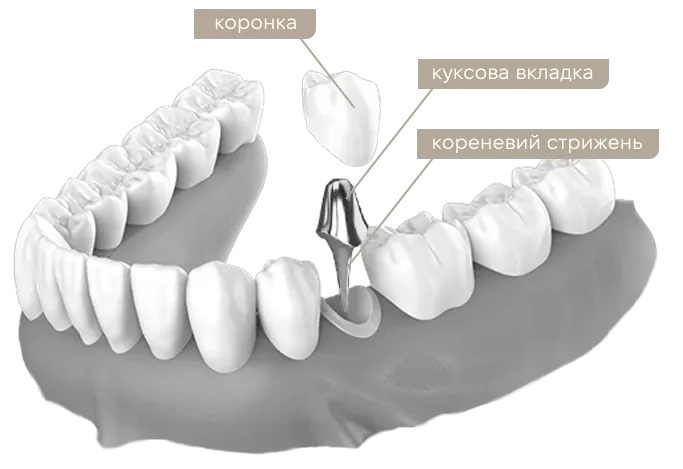
In order to avoid losing a tooth when it has been destroyed by trauma or decay, a restoration procedure is required. If the damage is minor, a dental filling may be sufficient, but if the damage is severe, a core inlay, which will be covered by a crown in the future, is recommended. This is a mini denture that is fixed in the root part of the tooth and acts as a support for the crown. The inlays can be cast or collapsible. The materials they are made of also differ. Today, inlays made of zirconium dioxide, ceramic or metal are available.
If you are looking for durable and reliable prosthetics in Kyiv, choose the services of DENTART Clinic. For severely damaged teeth, we fit dental inlays under the crown, treating or re-treating the root canals beforehand if necessary. Make an appointment online for a convenient day and time!
Make an appointment

Advantages of inlay core
- Helps preserve the tooth even with up to 90% destruction.
- High strength and an excellent marginal seal.
- Promotes even distribution of forces onto the root.
- Service life typically 15–20+ years.
- Better protection against root fracture compared with dental posts.
- Well-suited for teeth with multiple canals.
Price


Our doctors






Prosthetics (orthopaedics)
- Initial appointment with an orthopedic dentist
- Digital Smile Design (DSD)
- Dental crowns
- Ceramic crowns
- Metal-free crowns (zirconium)
- Metal-ceramic crowns
- Veneers
- Lumineeres
- Micro-prosthetics of teeth (inlays)
- Prosthetics on implants
- Bridges
- Clasp dentures
- Dental onlays
- Initial appointment with an orthopedic dentist
What is a dental inlay and what is it for?
An inlay is an orthopaedic structure that is made individually for a specific patient in a dental laboratory. It is used to restore severely damaged teeth (more than 50%) and serves as a secure support for the crown (other prosthesis). If, in this case, a post with a filling is inserted instead of an inlay, subsequent chewing stress will cause the inlay to fall out and a denture will have to be inserted again.
In such a situation, a broken post can also damage the tooth root, which is an indication that the tooth must be extracted. Then either an implant or a bridge will be needed.
An inlay, on the other hand, as opposed to a single post, allows for proper load distribution, strengthens the tooth and ensures a long-lasting and durable prosthetic restoration.
Indications for the use of core inlay
A dental inlay at DENTART is shown for:
- severe destruction of the tooth, but the possibility of preserving it;
- a crown to strengthen the tooth;
- the need for root treatment before a crown can be fitted;
- planning the installation of the bridge and the creation of a support for this structure.
Types of dental inlays
Today, a variety of tooth inlays can be used. They differ in the way they are made, the materials used and the number of pins (fixings in the tooth canals).
Tooth inlays can be cast or collapsible. The former are usually used to strengthen and restore teeth with 1 or 2 canals. The collapsible inlay can have 3 or 4 pins for fixation in the appropriate number of canals.The collapsible design of the inlays makes them easier to fix, but they are more expensive because of their more complex construction.
Metal remains the most popular fabrication material. But a zirconia core build-up inlay can also be used (in combination with crowns of the same material) to ensure perfect aesthetics.
Inlay core vs. dental post

-
Very strong and reliableA one-piece cast design with longevity from 15+ years.
-
Requires at least 2 visitsMade individually in a dental laboratory.
-
For very severe destructionRecommended for very severe destruction (about 70–90%), suitable for multi-rooted teeth.
-
Even load distribution and lower riskMonolithic design helps minimize root fracture risk.
-
Longer and more expensive
-
Moderate strengthA post-supported filling is more prone to chipping; overall lifespan 5–10 years.
-
1–2 visitsPrefabricated posts are used. The filling is built directly in the mouth.
-
Used for severe destructionPosts are used when the tooth is 50-70% destroyed and are less adaptable to units with multiple canals.
-
Higher riskMicro-gaps may remain. The risk of root fracture can increase.
-
More affordable
Stages of Inlay Core Placement
-
Which is more reliable: an inlay core or a dental post?
An inlay core is generally the more reliable solution for restoring severely damaged teeth. A dental post with a filling often lasts 5–10 years, while an inlay core with a crown can exceed 20 years. It distributes chewing forces more evenly, reduces micro-crack risk, and lowers the likelihood of root damage.
-
Inlay core or an implant — what should I choose?
If the tooth can be preserved and extraction avoided, an inlay core followed by prosthetic restoration is usually recommended. If extraction is indicated (e.g., extremely severe destruction or root infection), implantation with a crown is often the best option. The optimal choice in your case should be determined by DENTART specialists in Kyiv.
-
What material is best for an inlay core?
Modern inlay core is commonly made from metal or zirconia. Metal is the most widespread option: casting technology provides a durable restoration at a reasonable cost—still a strong choice for posterior teeth. Zirconia may be preferred for improved aesthetics and to reduce the risk of metal show-through, especially when paired with zirconia crowns.
-
Is it painful to place an inlay core?
No. The procedure is painless. If needed, local anesthesia is used. When complex endodontic treatment is involved, other options may be considered, such as deep sedation. During placement, you may feel pressure, but not pain.
-
Can an inlay core be placed on a “live” tooth?
No. An inlay core is used when a tooth is severely damaged (about 70–90%) and typically requires endodontic treatment or already lacks a nerve (a “dead” tooth). It is cemented into the root canal, which is not possible with a vital pulp. If preserving the nerve is feasible, the doctor will recommend alternative restorations (inlays, veneers, etc.).
-
When should an inlay core be avoided?
In short, it is not recommended in two situations: when the pulp can be preserved and more healthy tooth structure can be retained (using an inlay/veneer/crown supported by the tooth), or when saving the tooth is highly uncertain and the risk of complications/extraction is high. Contraindications can include root or surrounding tissue inflammation, thin/curved/short root canals, and pathological mobility. In such cases, extraction with implant-supported restoration or a bridge may be recommended.
-
Can an inlay core be used with periodontitis?
Periodontitis can be a contraindication, but in some cases placement may be possible. If recommended periodontal treatment has been completed, stable remission has been achieved, bone support is adequate, and the tooth is stable (or has only minimal mobility—grade 1), an inlay core may be considered. Splinting may also be recommended. In flare-ups and/or significant mobility, alternative treatments are preferred.
-
Can an inlay core break?
In theory, yes, but this is extremely rare. A slightly more typical (still uncommon) complication is root damage. Excessive chewing loads, bruxism, or periodontitis can contribute. Overall, an inlay core is considered highly reliable; root cracks and fractures occur far more often with the alternative approach — dental post + filling.
-
Must a crown always be placed over an inlay core?
Yes. An inlay core must be used together with a crown (or another prosthodontic restoration, such as a bridge). It serves as the foundation for the dental crown/bridge. Using it without a final prosthetic restoration will not provide proper aesthetics, function, or long-term durability.


